A Family Guide to Europe Car Rental
You might have heard that train travel is the best way to get around Europe but that’s not always true. In fact, our family prefers to rent a car in Europe most of the time, but there are some things you should know first. Renting a car in Europe isn’t the same as in the U.S., there are so many countries, languages, rules, and road signs to navigate. After traveling with kids in Europe for 12 years, I can say that it might seem intimidating at first but after you read this, you’ll be more well-prepared to handle it all. Once you get used to driving in Europe, you’ll realized it’s actually a really lovely way to travel and explore the continent.
If you’re ready to dive into checking prices and comparing, check out Discover Cars where you can easily compare rates across car rental companies.
Sometimes I use affiliate links which don’t cost you a penny more, but may credit me a small commission if you make a purchase. Thanks for using them to help support the work that goes into my content!
Europe Car Rental vs. Train Travel—Which is Right for Your Family?
The first time we moved to Germany, everyone raved and raved about the train system and how great it was for traveling. And they were right—it is great! But once we started traveling with kids using trains, we started to see the cracks: hauling bulky baggage and strollers on and off the train, still needing to get a taxi if your hotel is not next to the train station, expensive train tickets for long-distance trains, and kids having freedom of movement (this is great for some kid but not others).
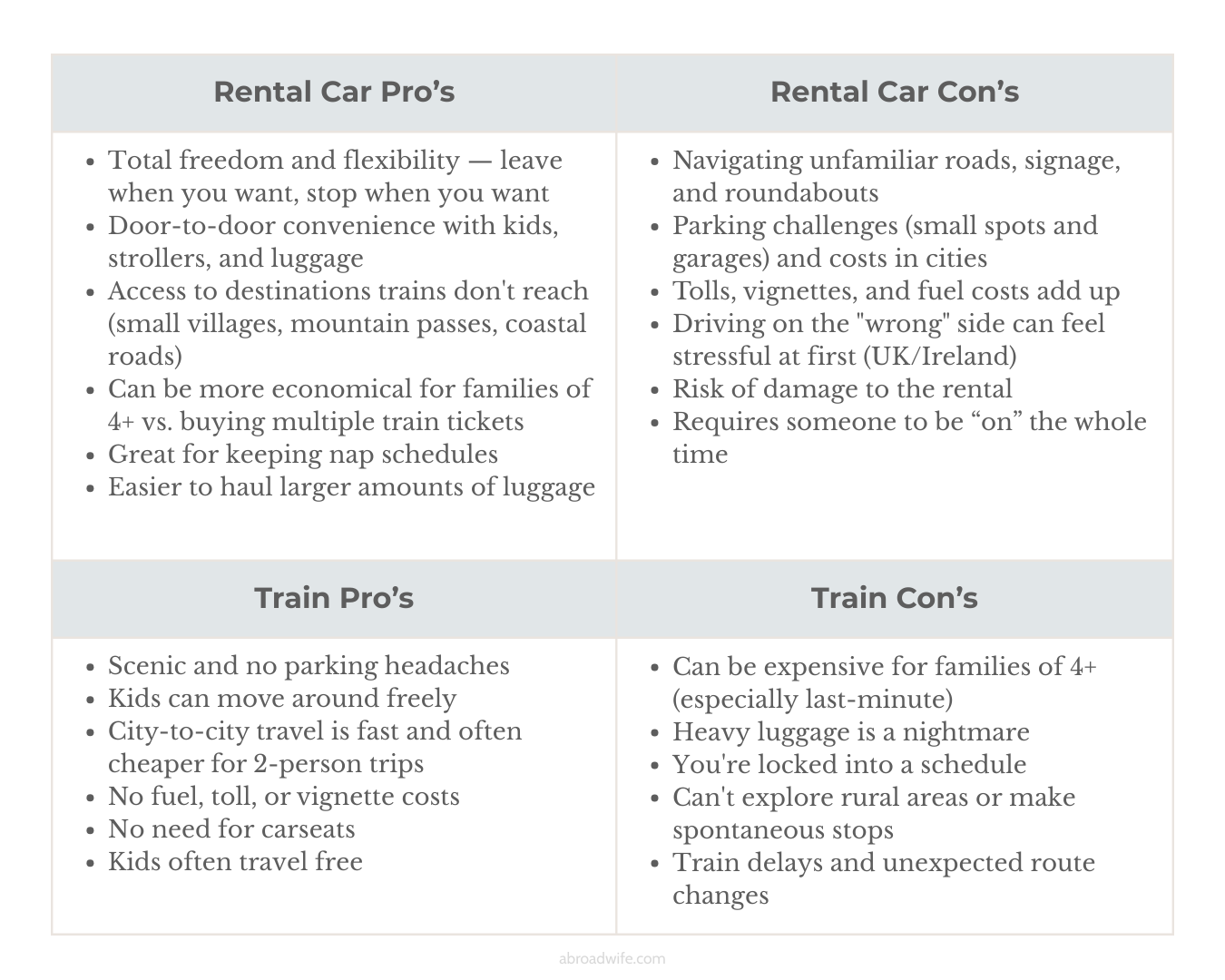
Quickly, we learned what kind of trips in Europe were more suited to trains and what kind of Europe trips we preferred to rent a car. Here’s a quick breakdown of the pros and cons to each method of transportation.
Car rental PROS:
Total freedom and flexibility — leave when you want, stop when you want
Door-to-door convenience with kids, strollers, and luggage
Access to destinations trains don't reach (small villages, mountain passes, coastal roads)
More economical for families when buying multiple train tickets
Great for keeping nap schedules, car = mobile nap spot
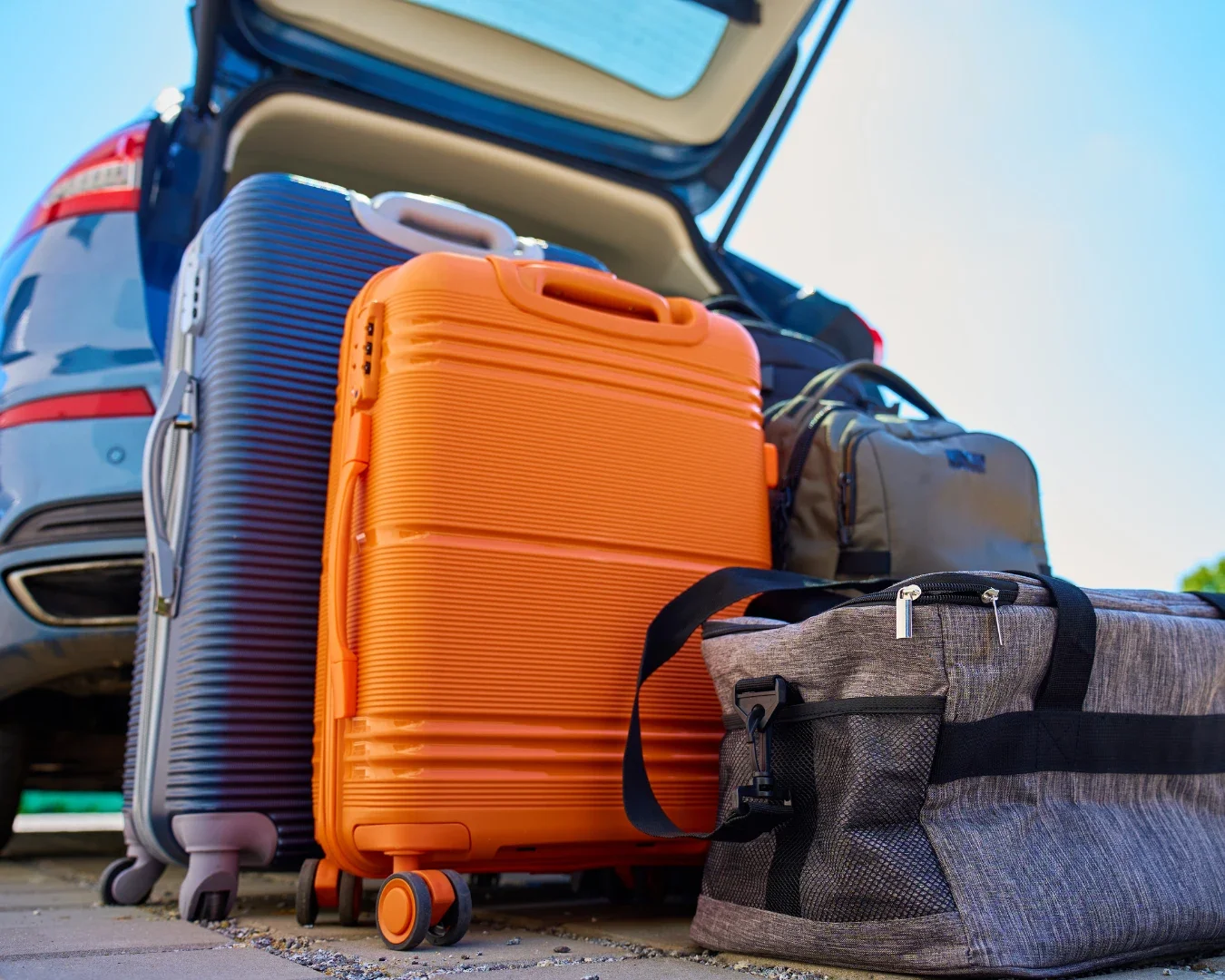
Luggage goes in the trunk, not overhead racks or at your feet
Car rental CONS:
Navigating unfamiliar roads, signage, and roundabouts
Parking challenges and costs in cities
Tolls, vignettes, and fuel costs add up
Driving on the "wrong" side can feel stressful at first (UK/Ireland)
Risk of damage to the rental
Train travel PROS:
Scenic, and no parking headaches
Kids can move around freely
City-to-city travel is fast and sometimes cheaper for 2-person trips
No fuel, toll, or vignette costs
Train travel CONS:
Expensive for families when combining multiple tickets, seat reservations, and itinerary legs
Heavy luggage is a nightmare
You're locked into a schedule
Can't explore rural areas or make spontaneous stops
Schedule can be delayed or even canceled, causing upheaval in your itinerary
My take:
You’re going to Paris with one or two day trips-skip the rental car.
You’re going to the Alps and staying in multiple different locations-get a rental car.
Most of the time we choose to have a rental car in Europe. The times were we would opt not to get one is if we were going to spend the majority of our time in a major city. Renting a car for a single day or two or after you leave the major city is also an option.
Choosing Car Rental Agencies in Europe
My first stop when looking for a Europe car rental is to use a platform where you can easily compare rates and cars from multiple brands like Discover Cars or Auto Europe. You can book with your desired company through these websites, often they have excellent cancellation policies which is why I’m a big fan.
This is the easiest way to compare and narrow down the selection.
Some of the rental car companies in Europe that you will commonly see:
SIXT — German brand, wide fleet including BMWs and Audis, great for Germany/Austria; pricier but reliable
Hertz — Familiar brand, strong airport presence across Europe, solid fleet of vehicles
Avis — Widely available, loyalty perks, competitive pricing
Europcar — Strong regional coverage, good family vehicle selection, often less expensive than the other brands
We’ve had success with most of the major car brands. Keep in mind that you may have some rental car benefits associated with your credit cards. Look into your specific card benefits to see if it helps your price.
Pay Attention to This When You Book
One thing you should always note when choosing a company is if the rental car company has an in terminal counter or if they are off-site. If you look carefully, you’ll see this noted in the information. Off-site might say something like “courtesy van”.
Often, these companies offer much lower rates but you need to factor in that you’ll be waiting for someone to pick you up and take you out to the rental car lot. They may not bring a vehicle that comfortably fits your family and your luggage and they probably won’t have a car seat. This is an extra step that can be a pain but sometimes it might be worth the small sacrifice. Whatever you decide, it is important that you know at the time of booking what you’re getting into.
My tips for booking a rental car in Europe:
Always book in advance, last-minute availability can be poor and prices spike
Book early = better vehicle selection, especially for larger cars
Double-check cross-border fees before booking (returning in a different country or different locations can be expensive)
Confirm what's needed at pickup: many companies require an International license
Pay attention to the total price and any extra fees that will increase your total
Check reviews of the company, especially for lower priced companies and ones you don’t recognize
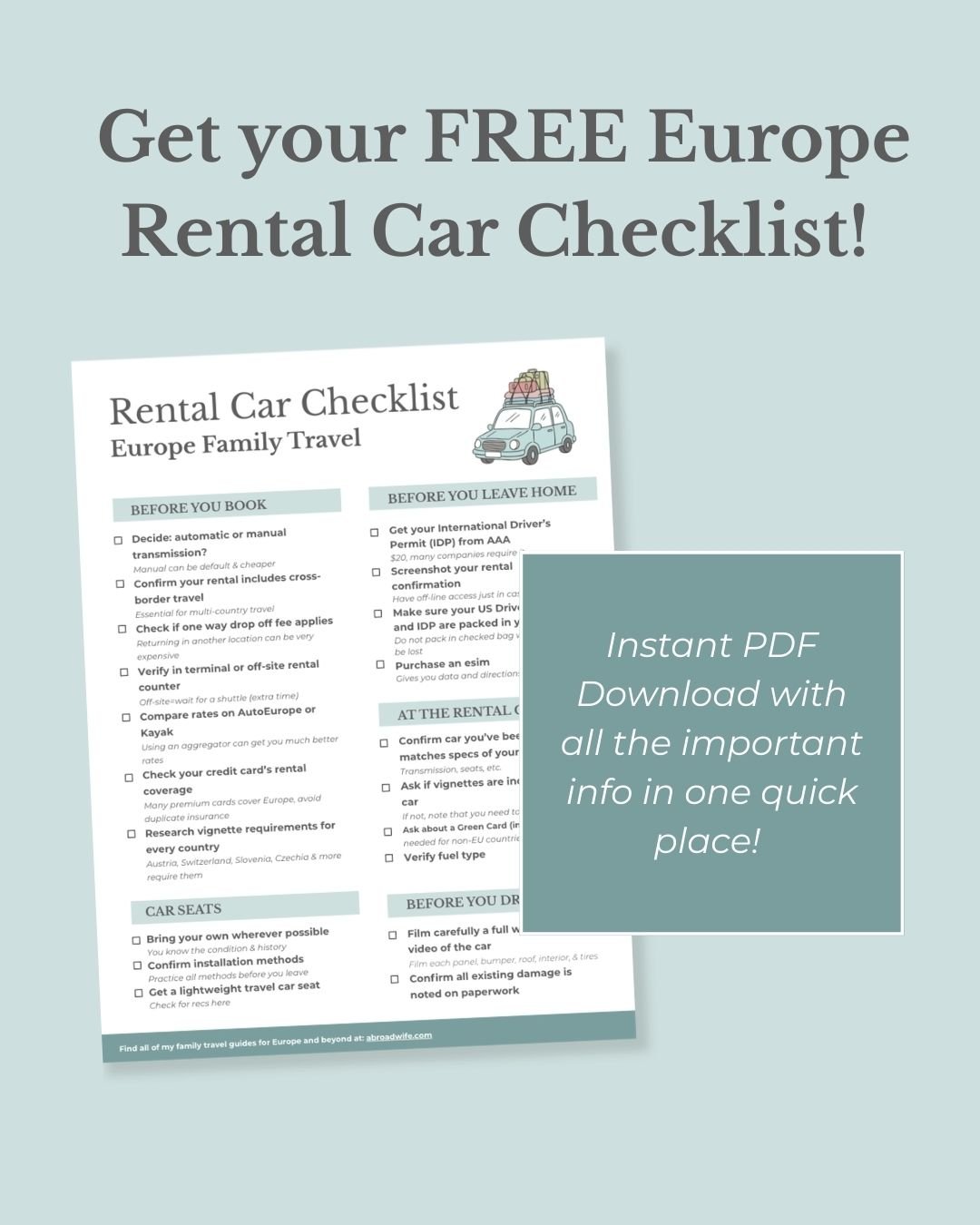
Do I Need an International Driving Permit in Europe?
The short answer is yes, you should get an International Driving Permit (IDP) before your trip to Europe. Many companies require you to show it upon picking up the rental car and if you were to get pulled over or involved in an accident (knock on wood) you could be fined for not having one. An IDP covers 150 countries and translates your information into 10 different languages.
It’s very easy to get one through AAA. You can go in person or submit your application by mail. Make sure to do this well in advance of your trip. You don’t need the license to book a rental car in Europe, but you might need it when you pick up the car. You should plan to have your passport, credit card, IDP, and booking confirmation ready when picking up your rental car in Europe.
Many times we have not been asked to show it, but this is one of those things that is worth the $20 to get to avoid any potential headaches down the road.
What do you need to pick up your rental car in Europe?
Your original U.S. Driver’s License
Passport
International Driving Permit
Credit Card
Booking Confirmation.
Rental Car Costs, Insurance, Money-Saving Tips
Oftentimes, rental car agencies will spring hidden fees and charges on you. Make sure you are reading the fine print of your rental agreement so you know what is covered and what is an additional expense.
One of the biggest things that adds extra expense is buying the insurance coverage at the counter. The agent will try to scare you into this, and it does sound scary! The best thing you can do is contact your current insurance provider to see if you have coverage abroad and check your credit card benefits to check what their policy can cover. Do this BEFORE you book. Knowing what coverage you already have or where the holes are is the best thing you can do to confidently decline the expensive insurance at the counter.
If you do need to purchase additional insurance, I recommend doing it through a third party provider when you book the rental. I would do this through Discover Cars at the time of booking.
Tips to Save Money:
Book a manual transmission
Know your credit card car insurance coverage to avoid the expensive upsell at the counter
Only have one driver for your trip
Drop off the car in the same location that you pick it up
Bundle your car rental with your hotel & flight
Bring your own car seat
Get an eSIM to use navigation data on your phone instead of paying for a GPS
Know if you have a mileage limit
Things that will Often Cost More:
Adding an extra driver
Buying the expensive insurance plan at the counter
Crossing borders into another country
Returning a car to a different location than you picked up at
Damage to the car (to include excessive dirtiness-sand from the beach)
Snowchains
Ski Rack
Prepaid fuel plan
Going over your mileage limit
Returning your car late. Most companies will charge you a full extra day’s rate if you don’t return on time.
Damage-take detailed videos of the car’s exterior and interior before leaving the lot. Make sure any damage is documented.
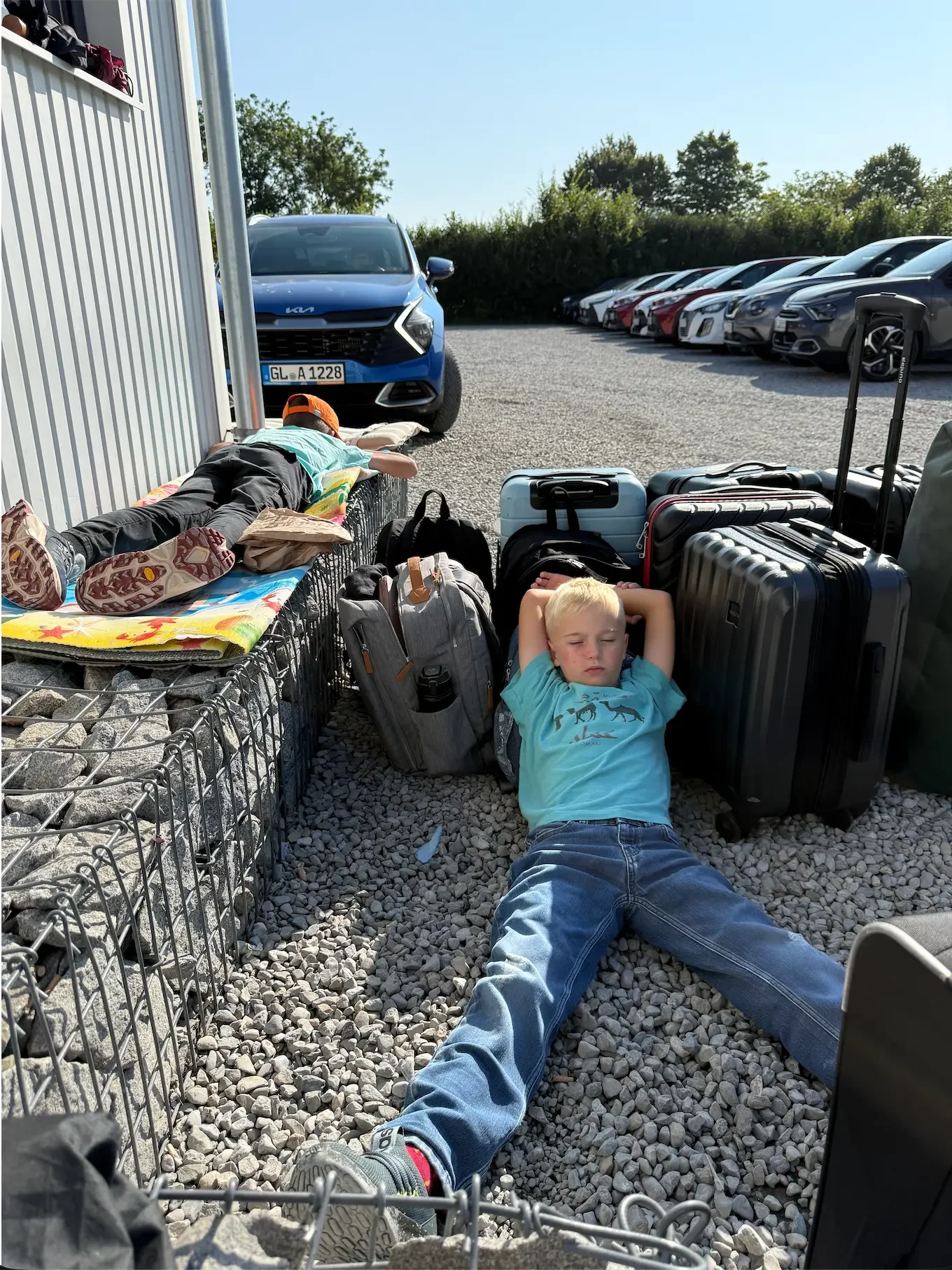
Our kids were less than thrilled to wait while we picked up our off-site rental car.
Manual vs. Automatic Transmission
Many Americans wonder, “Are automatic transmissions available in Europe and why are they so much more expensive?”In Europe, it is still very common for cars to be manual transmission, in fact it is more of the default. Automatic cars are available to rent in Europe but manual cars are more widely available. If you’re like me and never learned how to drive a stick shift, then it’s critical that you note whether you’re booking a manual or automatic transmission.
Most of the time the manual transmission car will be less expensive than the automatic by around $10-$20 per day.
Vehicle Size—What to Actually Book
I’m going to make a blanket statement—European roads, parking garages, and parking spots are smaller than you are used to in the U.S. Cars are also generally smaller to accommodate this. Be careful about the car that you are booking to make sure that you will have enough space for your family and your luggage.
Keep in mind that you’re booking a “Volkswagen Golf or similar”. The car you get may not be the exact model you book. Take a look at how many passengers it fits and how much luggage it says it can fit. Also pay attention to how many doors it has.
If you have a spatially gifted person in your family, they may want to look up examples of the car models listed to see pictures or videos of the car to get a better idea if everything is going to fit.
Booking cars for Big Families on Ski Trips
Now that we have to fly to do our ski trips, we have become big van people. One year for our ski trip we booked an SUV but there was no way to reserve the ski rack in advance. When we picked up our car, we were upsold and upsold because the car we booked couldn’t accommodate a ski rack (which is ridiculous but I digress). We ended up canceling our booking on the spot and rebooking two cars with a different company instead because it was cheaper than the upsell.
Obviously, one family driving two cars for a trip is a bit silly so now we just get the big Sprinter van to fit us and the skis.
Also important to note, snow chains are an extra cost when you are renting a car. But some areas require chains and you could end up needing them.
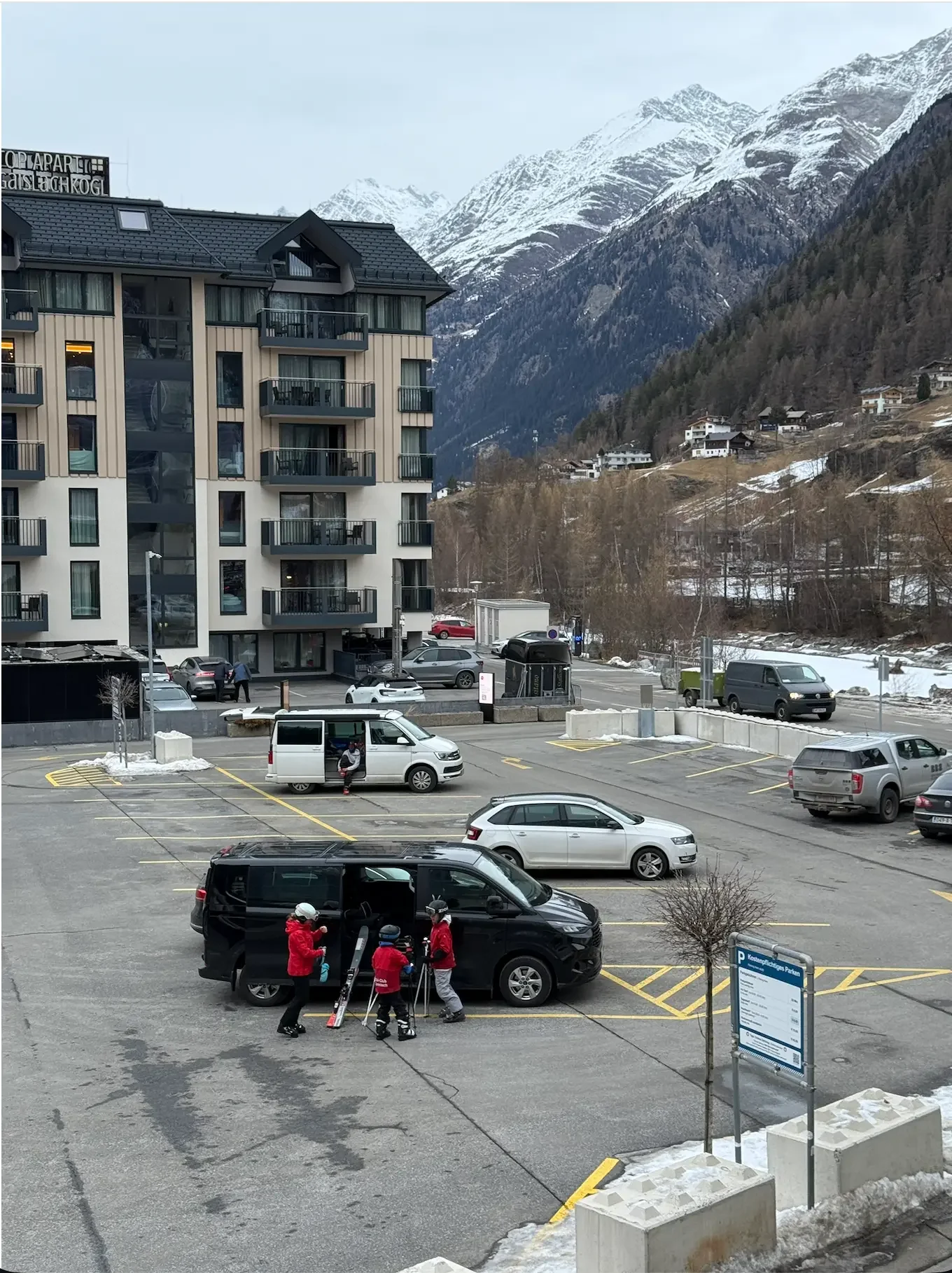
Vans aren’t too uncommon in Europe, they are necessary sometimes with big families and lots of gear.
Booking a Car in Turkey
This has never happened to us anywhere else but it happened TWICE in Turkey. We booked a car that says it has 5 seats but when we get the car it only has 4 seatbelts. WHAT?! I don’t know why a car like this is even sold.
We had to push the rental car company to give us a different car at the same price because obviously, we aren’t going to choose a kid to not have a seatbelt and hope for the best. Luckily, we were able to get new cars both times but one of those times it was a fight, at midnight, after a late flight with tired kids.
The European street reality
Larger cars are not as maneuverable on Europe's narrow, winding roads. Old town centers, mountain villages, and coastal roads are not built for American-sized SUVs
Smaller cars are easier to park, cheaper on fuel, and fit into tighter spaces — but they won't fit a family of 5 with luggage
General Size Guidance by Family Type
2 adults + 1–2 kids with light luggage → Compact or mid-size (VW Golf, Peugeot 308 class). Most economical, easiest to drive
2 adults + 2–3 kids with standard luggage → Estate/station wagon or mid-size SUV. Best balance of space and maneuverability
Large families (5+ people) or lots of gear → Full-size SUV or minivan (Volkswagen Touran class). Book early — limited availability
Station wagons/estate cars provide extra space for luggage and are ideal for families or travelers with sports equipment.
Fuel Types Explained
Rental cars in Europe are not always powered by gasoline, or petrol, as you might hear it called in Europe. You could get a car that takes gas/petrol, diesel, is electric, or hybrid. Make sure you note at the time of pickup what type of fuel you should be putting in the car so you don’t put in the wrong kind of fuel. You should also double check this on the car by looking for the sticker inside the gas tank door.
In Europe, fuel is measured in liters, not gallons and distance is measured in kilometers not miles.
1 gallon = 3.785 liters
1 mile = 1.6 kilometers
In general, fuel is more expensive in Europe than in the United States.
If you rent an electric car, make sure to map out available charging stations along your route. Electrical charging stations are becoming more and more popular and the infrastructure is becoming quite robust in most countries. Use this app to find charging points.
Funny Story…
I was given a hybrid without knowing it when I rented a car in Germany. I had never driven a hybrid before. When I was turning on the car, it was silent and I was convinced there was something wrong with the car. After many minutes sitting in the parking lot and trying over and over to turn the car on and off, I realized it was just quiet and finally drove away as normal. Whoops! First time for everything!
Car Seats in Europe
The core question: bring yours or rent one? I recommend when possible, you should bring your own car seat.
I know traveling with a car seat is a pain, I get it. We are out of that phase now and it does make it much easier. But when we were in this phase, we brought our own car seat. In fact, I even bought a special car seat specifically for travel so that I didn’t continually have to uninstall and reinstall the seat. Also the seat I bought for travel was MUCH lighter than my everyday one.
Here’s why I suggest you bring your own:
You know the condition
You know if it has been in any accidents
It guarantees you’ll have the right seat for your child
When you rent from the rental car agency, it might sound convenient, but you won’t truly know what you’re going to get. It could be a really damaged or worn out seat. It might not be the correct specifications for your child’s age/height/weight. And it is quite expensive to add on this fee.
Once, we traveled to Slovenia without our car seat thinking we would rent when we got there and we were quickly put off by the seats we were offered. We ended up going straight from the airport to a baby store to buy our own booster seat. Something that could’ve been avoided had we just brought our own from home.
These are some of the best travel car seats that traveling parents have been raving about for years.
Way B Pico (Splurge)
This seat folds up and can be carried in a backpack carrying case. It has been a long-time favorite of well traveled parents for it’s lightweight portability.
[Shop on Amazon] [Shop on Way B]Cosco Scenera Extend (Budget-friendly)
This is the seat we purchased specifically for traveling. It is a low cost way to make traveling with kids much easier. Add a wheeled cart to pull it through the airport and you’re really in expert mode.
[Shop on Walmart]Bubble Bum Booster (Best for older kids)
This is an inflatable booster seat, so it packs down to basically nothing and then you can inflate upon arrival, so easy!
[Shop on Amazon] [Shop on Target]
But I Heard that American Car Seats Don’t Meet European Safety Rules?
This is true, American safety standards and European safety standards are not in complete alignment. However, I still recommend you bring your own seat. There are a lot of Americans living abroad using their own car seats every day. I have never heard of anyone getting ticketed for an improper car seat, I’m not saying that can’t happen but I think it is unlikely. And when given the choice of my own car seat that I know is high quality but doesn’t match the rules versus a car seat that matches the rules but is in poor or questionable condition, I will take my own car seat every time.
If your car seat requires ISOFIX anchors, be sure to verify the car that you are renting has them. I recommend brushing up on how to install your car seat with a seatbelt as we had to do this often. It is important you know a backup installation method.
European car seat age/height rules:
Most of the EU requires car seats for children under 135cm (about 4'5") tall — roughly age 10–11 for most kids
Germany, Austria, Switzerland, and Italy require seats up to 150cm (about 4'11") — taller than the U.S. standard
Children under 135cm need a booster seat in many countries, but Germany, Austria, Switzerland, and Italy require seats up to 150cm.
*always verify the rules and requirements before you travel as they can change and are very country specific.
Understanding Vignettes & Tolls
Some countries in Europe require vignettes for use of their roads or highway systems. You need to know about this before you travel and whether your destination requires one. Some countries (Germany & France) require emissions stickers to enter certain cities. You should ask if your rental car has these stickers before you drive away. If it doesn’t you need to avoid these emissions zones or you’ll receive a hefty fine.
What is a vignette?
A vignette is a road tax sticker (or digital permit) required in certain countries to use highways. Unlike traditional tolls based on distance, vignettes operate on a time-based system (7 days, 10 days, one month, one year, etc.)
You must buy a vignette before using the country’s highways. Sometimes they are a physical sticker that must be affixed to the windshield. Many countries have now switched to digital/electronic vignettes linked to your license plate You can even book these online instead of stopping to buy one.
Which countries require vignettes?
Vignettes are required for driving along certain roads in: Bulgaria, Czech Republic, Hungary, Romania, Slovakia, Slovenia, Switzerland, and Austria.
Germany, France, Spain, Italy, and the Netherlands do NOT use vignettes, but may have toll booths on some highways
Switzerland requires an annual vignette (~€55) even for a short visit — it must be attached to the windscreen and is valid for a calendar year.
What do they cost?
Prices range from as little as €5 to over €100, depending on the country and validity period. Most countries offer 7-day, 10-day, monthly, and annual options. You can buy them from gas stations near the border or at the border. You’ll see signs advertising the sale of the vignette. Sometimes you can buy them online while you’re driving down the road (like for Austria). Make sure if you purchase online you’re using the official site or you might end up paying more than you need to.
Who handles it when you rent a car in Europe?
Sometimes the rental company includes it; often they don't — always ask at pickup
If you're crossing into a vignette country yourself, buy it at the border crossing, at a gas station, or purchase digital versions online in advance
Penalties for not having a vignette are steep: Austria fines €180+, Slovenia up to €800. This is not something to risk.
What Tolls do I have to pay driving in Europe?
In addition to vignettes for some countries, you may also encounter toll roads. Most of the time you can pay a toll with your US credit card, but I recommend having cash available just in case you come across one that won’t accept your card (has happened to us in France). There are some highway systems in France that require you to go online and pay your toll within a certain time of using the motorway or you’ll be sent an expensive fine. You’ll see signs (in French) advertising this. Set a reminder in your phone so that you don’t forget.
You can use this website to help you plan your route and find out what tolls to expect.
Crossing Borders in a Rental Car
You need to inform the rental car company if you will be driving across borders in the rental car. Most of the time this is not a problem but can incur an additional fee. Sometimes crossing borders or crossing specific borders is not allowed by the company.
Ask the rental car company if a green card (international insurance certificate) is needed for the countries you’re visiting. Sometimes this is required in non-EU countries. Schengen zone travel is generally easier (no passport control between most EU countries), but rental restrictions are a separate issue from border controls and you still need to disclose if you will be crossing borders.
Driving Laws & Practical Driving Tips
How does a roundabout work?
One road feature that is super common in Europe but rarely found in the US is a roundabout. So here’s how it works (in a left-hand drive country):
Pull up to the roundabout slowly and check to the left to see if it is clear. If yes, proceed without stopping fully. If no, stop and wait for the roundabout to be clear. Do not put on your turn signal. Enter the roundabout and drive counter-clockwise until you’re appropriate exit. The GPS will tell you to take the 1st, 2nd, or 3rd exit so pay attention. Turn on your turn signal to EXIT the traffic circle and let waiting cars know you are exiting.
Traffic Signs
There are so many traffic signs that are different than what you see in the US but it would be nearly impossible to learn them all before your trip. But I recommend a quick Google check of “road signs in X country” to give yourself a brief overview. The most important ones to note are probably speed limit signs, do not enter signs, and parking signs to avoid tickets.
Driving Laws
The driving laws can vary slightly from country to country. It’s best if you research the exact countries you’ll be traveling to get the specifications. Things to note: acceptable blood alcohol limits, car seat rules, rules about right on red, etc.
Car-free towns
It is not uncommon for a town to have a car-free center. Make sure to pay attention to any do not enter signs. Research before you go to avoid making a mistake. If it is car-free, you’ll need to find a parking spot or garage to leave the car at while you explore the town.
Parking App
Download the EasyPark App before you go. This app is widely used across several countries and allows you to pay for parking on your phone-so much more convenient than needing to feed a meter! You can also top up from your phone instead of running back to your car.
Whew! That was a lot of information, who knew there was so much to think about with renting a car in Europe! Hopefully, this helps you feel more informed and comfortable about what to expect before picking up your Europe car rental.
We are big proponents of driving around Europe. We love the flexibility it offers and the ability to make little detours. There are so many places we’ve been able to explore thanks to the freedom of a rental car. It helps our family fill our trips with special memories and more ease.
There are quirks to driving in Europe, but once you get used to it and experience what having a car will open up for you, I think you’ll be sold.